A Carbon-Neutral Claim, Carefully Read
Read a carbon-neutral claim with care: identify its boundary, accounting choices, and unanswered environmental questions before accepting its scope.
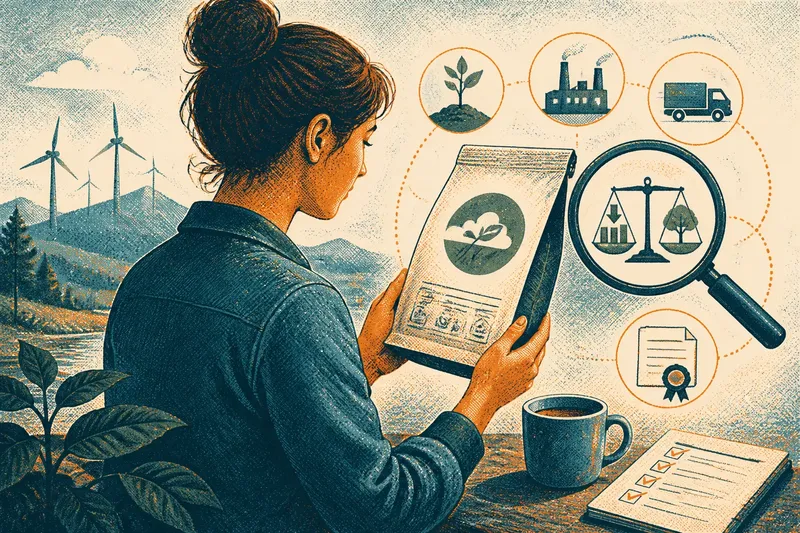
A carbon-neutral claim can sound broader than it is. When you see one on a product label, company page, or event notice, start by asking what exactly is said to be neutral: a product, an organization, a service, or a defined activity. That first distinction helps you read the claim without treating it as a verdict on every environmental effect.
What does the claim actually cover?
Look for the noun attached to “carbon-neutral.” A claim about a company’s operations may exclude the emissions associated with the goods it buys, the products it sells, or their use and disposal. A product claim may cover a particular item or a batch, not the full range of a brand’s activities.
Check the boundary statement, often found in a footnote, methodology page, or linked report. It should identify which activities and emissions are included and which are left outside. If the boundary is hard to find, treat the claim as limited information rather than a comprehensive account.
Say you are reading a fictional coffee roaster’s product page. It calls one bag of coffee carbon-neutral, while a linked note says the accounting covers roasting and packaging but not the coffee’s cultivation or brewing. You can then describe the claim accurately: it addresses a stated portion of the product’s footprint, not every part of its journey.
How does the accounting work?
Carbon accounting translates activities into estimated greenhouse-gas emissions, commonly expressed in carbon-dioxide equivalents. A claim may include more than carbon dioxide, so check whether the method names the gases covered and explains how emissions are converted into a common unit.
Pay attention to the period and data behind the calculation. An organization might use direct fuel records for some activities and estimates for others, especially when suppliers or customers are involved. The report should make those choices visible enough for a reader to tell what is measured, what is estimated, and what remains uncertain.
Also look for the distinction between reducing emissions and balancing them. A company may report reductions within its own operations and separately use carbon credits to counter a remaining amount. Those are different actions; a single “neutral” label can obscure the difference unless the supporting material describes both.
What do carbon credits add to the claim?
Credits generally represent a claimed climate benefit outside the activity being balanced, such as avoiding emissions or removing carbon from the atmosphere. Ask what kind of project issued the credits, where it operates, what accounting method applies, and whether the claim explains how the benefit is tracked.
Check whether the same claimed reduction could be counted by more than one party. The documentation should explain who owns or retires the credit and how the accounting prevents duplicate claims. If this is unclear, you cannot tell from the label alone how the credited benefit relates to the organization’s own emissions.
Credits also differ in what they represent. Avoided emissions and carbon removal are not interchangeable descriptions: one concerns emissions that a project says it prevented, while the other concerns carbon taken out of the atmosphere and stored. Read the project description rather than assuming that every credit has the same climate effect or durability.
What should you check first, and what can wait?
Use a short reading routine rather than trying to resolve every technical question at once. Start with the claim itself, then follow the evidence only as far as it answers a question relevant to your decision.
- Find the exact subject. Decide whether the claim concerns a product, company, service, or event; narrow your interpretation to that subject.
- Locate the boundary. Note the activities and emissions included, plus any major exclusions; avoid extending the claim beyond them.
- Identify the time period. Check which reporting year or product period the calculation covers; don’t assume it describes current operations if it refers to an earlier period.
- Separate reductions from credits. Look for figures or descriptions presented for each; treat them as distinct parts of the account.
- Read the credit information. Check the project type, tracking, and ownership or retirement details; mark any missing explanation as unresolved.
- Look for other environmental information. Check the same product or organization’s disclosures on materials, land, water, waste, or pollution; do not infer those effects from a carbon claim.
- Write a precise description. Summarize what the claim covers and what it does not establish; use that wording when comparing options or discussing the claim.
Keep this list beside the claim while you read; it helps prevent a narrow label from becoming a broad conclusion.
What questions should you ask about a carbon-neutral claim?
Does carbon-neutral mean zero emissions?
Not necessarily. The claim may describe emissions that remain after reductions and are balanced through credits, so inspect the accounting before interpreting it as an absence of emissions.
Does a carbon-neutral product have no environmental impact?
No. A carbon claim does not, by itself, answer questions about water use, land impacts, resource extraction, toxic pollution, or waste. Look for separate information on those issues if they matter to your decision.
Are all carbon credits alike?
No. Credits can represent different kinds of projects and claimed benefits, with different methods for tracking and accounting. Read the project details rather than relying on the word “credit” as a complete description.
What if the supporting information is missing?
State only what the label says and note that the scope or method is unclear. You can ask the company for the boundary, reporting period, and credit documentation, or compare the claim with another source that provides them.
What environmental questions remain outside carbon?
Carbon-neutrality is a claim about greenhouse-gas accounting, not a general measure of environmental performance. A lower-carbon option might still rely on materials that affect habitats, consume substantial water, create difficult waste, or involve local pollution. Those questions call for their own evidence.
Consider the whole decision that matters to you. For a household product, that might mean checking its materials, packaging, repairability, and disposal route alongside the carbon information. For an event, you may want to look separately at transport, food, energy, and waste policies rather than treating a carbon statement as a complete account of its effects.
Labels and supporting documents can use terms in ways that depend on their stated method, the manufacturer’s information, and applicable local rules. Where the precise meaning matters for a formal decision, check the relevant documentation or ask a qualified professional.
How can you describe the claim fairly?
Use wording that preserves the boundary. Instead of saying “the company has no emissions,” say that it claims carbon neutrality for a specified activity, period, or product and identify whether credits are part of the accounting. If the source does not explain those details, say so plainly.
A careful reading of a carbon-neutral claim does not require dismissing it or accepting it wholesale. It means separating the stated carbon account from the wider environmental questions it cannot answer, then asking for evidence where the gap matters. That distinction makes the claim easier to discuss—and keeps its promise no larger than its documented scope.