When a Metaphor Starts Doing Political Work
Learn how political metaphors frame public issues, spot the details they hide, and ask sharper questions before accepting the comparison.
A city council calls a housing shortage a “pressure cooker,” and the phrase makes urgency easy to feel: heat is building, something may burst. But it also nudges listeners toward certain causes and remedies while leaving others out. To read political metaphors carefully, notice what they spotlight, what they obscure, and what action their image makes seem natural.
Why does a political metaphor feel like an explanation?
A metaphor carries a familiar scene into an unfamiliar argument. If a public debate is described as a “race,” people may focus on speed, winners, and falling behind. If it is a “battle,” they may attend to opponents, territory, and victory.
That transfer can make an issue easier to grasp, but familiarity is not evidence. The image supplies an implied story: who is acting, what is at stake, and what counts as success. Political work begins when that story steers judgment rather than merely illustrating a point.
Try translating the phrase into plain language. Ask which claim it stands for, then check whether the metaphor adds emotion or assumptions that the claim itself does not support.
What if the image makes one cause seem inevitable?
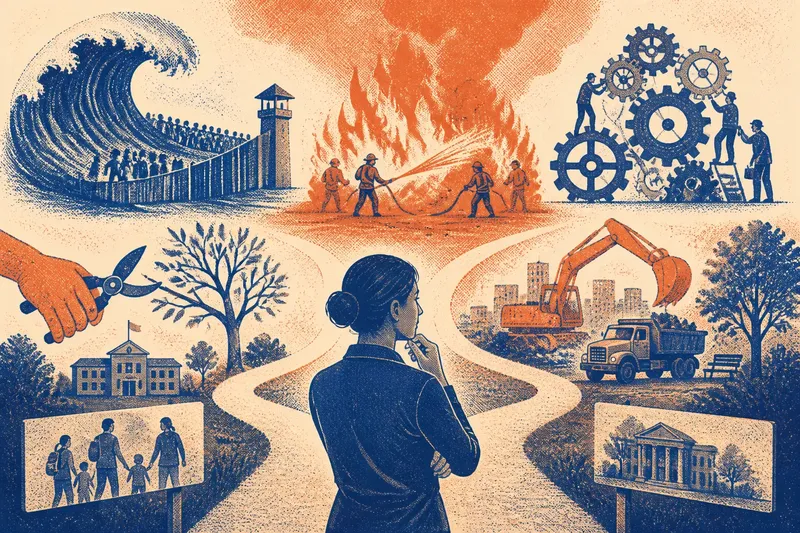
A common problem is treating a metaphor’s implied cause as the actual cause. Calling migration a “flood,” for instance, makes water seem to arrive in a single mass, press against a barrier, and threaten to overwhelm it. That picture can obscure the different circumstances and decisions behind individual journeys.
The cause is often the metaphor’s built-in plot. A flood suggests containment; a fire suggests suppression; a machine suggests repair. Those responses may be relevant, but the image has not established that they fit the issue.
Try asking what the metaphor assumes is causing the problem, then name at least one alternative explanation in literal terms. If the debate concerns people, institutions, or policy choices, describe those actors and actions directly before accepting a remedy shaped by the image.
What if the metaphor hides who has agency?
Some metaphors make events sound as if nobody chose them. A “wave of change” can make a policy shift seem like a force of nature, even when identifiable people made decisions that affected who benefits and who bears costs. The phrase may capture momentum while blurring responsibility.
Look for the grammatical subject as well as the image. Who is acting in the literal account? Who is acted upon? If a phrase turns deliberate choices into weather, machinery, or fate, restore the people and institutions to the sentence.
Say a school board member describes a proposed closure as “pruning the system.” Imagine the board has named several schools but has not explained how it chose them. A reader could ask who made the selection, what criteria were applied, and what consequences students would face; the observable result should be a discussion tied to decisions and effects rather than the image of routine gardening.
What if a metaphor makes consequences hard to see?
Metaphors often assign attention unevenly. “Cleaning up” a neighborhood can make a policy sound straightforward while leaving unclear what, or whom, officials intend to remove. “Investing in the future” sounds constructive but does not specify whose future, what is being funded, or what trade-offs follow.
The cause is usually compression: a vivid image condenses a complicated issue into a short phrase. That makes the phrase memorable, but it can push distributional questions out of view—who gains, who loses, and where the effects occur.
Replace the image temporarily with concrete nouns and verbs. Ask what action is proposed, who would experience it, and what changes would be visible in daily life. A metaphor may still be useful, but it should not stand in for those particulars.
How can you check whether a metaphor fits?
Does the comparison clarify a specific feature?
Name the feature the image helps explain, such as speed, scale, or interdependence. If you cannot identify one, the metaphor may be doing more persuasive work than explanatory work.
What does the image leave outside the frame?
List the people, causes, or consequences that disappear when the issue is described this way. Then look for a literal account that puts those details back into view.
Does the proposed remedy follow from evidence or from the image?
Separate the policy claim from the metaphor’s implied solution. A “leak” invites plugging; a “race” invites acceleration, but neither image proves that the corresponding action addresses the actual problem.
Would another metaphor change the judgment?
Try a different image, or remove imagery altogether, and see whether the perceived stakes or responsible actors shift. If they do, compare the underlying facts rather than choosing the most vivid phrase.
What if people disagree about the metaphor itself?
Disagreement is not always solved by finding a neutral-sounding substitute. People may reject an image because they think it misrepresents their experience, not because they missed its intended meaning. In that case, ask what feature they believe the metaphor distorts and what description they would use instead.
A useful response is to keep the argument open to correction. Say, in effect, “This comparison is meant to describe one aspect; does it also imply something I have not defended?” That invites scrutiny without pretending that language can be stripped of perspective.
When several metaphors compete, compare what each one makes visible and what it makes easy to ignore. Then return to the policy, evidence, and affected people rather than treating the most memorable image as the most accurate account.
How should you read the next striking phrase?
When a metaphor catches your attention, pause before accepting the story it supplies. Translate it into a literal claim, identify its implied cause and remedy, and check whose choices and consequences have gone missing.
Political metaphors are not automatically deceptive; they can help people discuss complex issues. The practical test is whether the image remains answerable to concrete details. Keep the phrase if it clarifies a feature, and set it aside when it starts doing the work that evidence, responsibility, or explanation should do.