The Public Sphere Before the Internet
The public sphere before the internet took shape in meeting rooms, print, and civic institutions. See how its settings shaped who could debate shared issues.
The public sphere before the internet took shape wherever people encountered questions that concerned more than their household and had some way to discuss them. A printed notice, a crowded coffeehouse, a town meeting, or a newspaper letter could bring a shared issue into view, but none offered equal access by default.
The phrase “public sphere” gives us a way to ask where public discussion happens, how ideas travel between private life and political authority, and whose voices count. Its history is not a simple march toward more open debate. Different settings widened discussion in some respects while keeping other people outside.
What did people mean by the public sphere?
The public sphere is the space of social life in which people encounter matters of common concern, exchange views, and form opinions that can reach institutions or officials. It is not a particular building, publication, or government body. It is a way to describe connections among people, communication, and public decision-making.
The concept also distinguishes public discussion from both private life and formal state action. A family conversation may become public when its subject enters a newspaper or meeting; a lawmaking body may act on an issue that people have debated elsewhere. The distinction is useful, but the boundary is never perfectly neat.
In the influential account associated with German social theorist Jürgen Habermas, the public sphere developed as a setting where private individuals could discuss public matters and scrutinize political authority. That account offers a framework, not a claim that historical societies achieved equal or fully open debate.
Where did public discussion happen before mass media?
Public discussion took place through local assemblies, markets, religious gatherings, taverns, coffeehouses, clubs, pamphlets, and correspondence. Each setting brought its own audience and rules. A meeting might let neighbors speak directly, while a pamphlet could carry an argument beyond the place where it was written.
Print helped connect people who could not gather in one room. Newspapers and pamphlets circulated accounts of events and arguments, giving readers material to discuss with others. Readers still needed access to printed material, time to read it, and social settings in which conversation could continue.
These settings often overlapped. Someone might hear a claim in a public gathering, encounter a related account in print, then raise the subject in a local association. The public sphere was less a single venue than a chain of encounters.
How did print change the shape of debate?
Print made it easier for arguments to travel beyond face-to-face circles and remain available for later response. A pamphlet could be quoted, criticized, shared, or answered in another publication. This gave public debate a memory: people could return to earlier claims instead of relying only on recollection.
But circulation did not mean universal access. Literacy, cost, censorship, distribution, and language all affected who could read and respond. Editors and printers also influenced which issues reached readers and how those issues were framed.
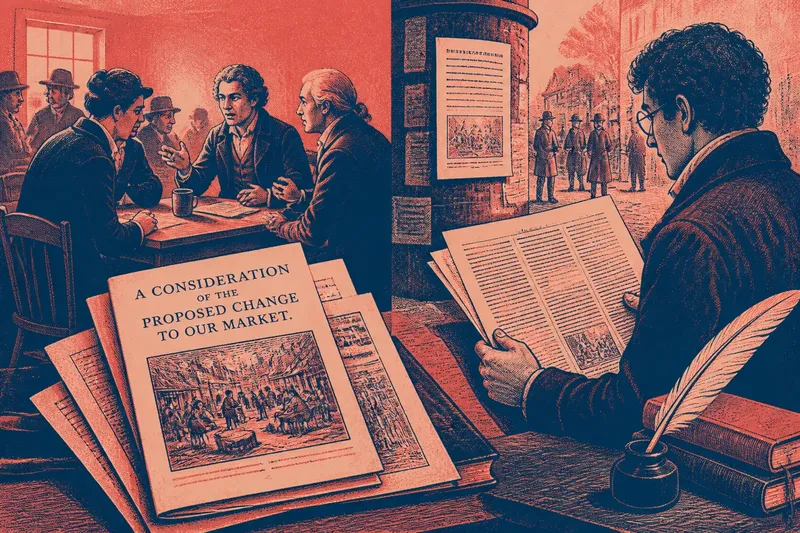
Imagine a fictional town where a pamphlet questions a proposed change to a shared market. Readers bring it to a neighborhood gathering, where traders and residents dispute its claims; a local paper then prints a reply. The observable result is a debate that crosses several settings, with each one shaping who participates and which arguments remain visible.
Who was included, and who was left out?
Access to public discussion depended on social position as much as on the existence of a meeting place or publication. Legal status, wealth, education, gender, race, occupation, and language could determine who was allowed to speak, whose writing circulated, and whose account was treated as credible.
Some people were formally excluded from political institutions yet still shaped public debate through family networks, community groups, petitions, religious organizations, or writing under another name. Others could enter a public venue but face ridicule, surveillance, or limits on what they were permitted to say.
For that reason, calling a setting “public” does not settle whether it was open in practice. A useful question is not merely who could enter, but who could speak, be heard, and influence what happened next.
Was the public sphere one shared conversation?
No. People often formed distinct publics around shared experiences, concerns, or identities, especially when dominant settings dismissed their views. These groups could create their own meeting places, publications, and channels for debate rather than wait for entry into an established forum.
Such publics did not simply sit outside the wider conversation. They could develop language for neglected problems, organize collective claims, and carry those claims into public institutions or broader media. Their existence also challenges the idea that one forum can fairly represent everyone.
At the same time, separate settings can limit contact across groups. The important point is not that a society needs one conversation or many, but that its different publics have meaningful ways to address shared institutions and be answered.
How did public debate reach political authority?
Discussion mattered politically when it could shape what officials, lawmakers, or institutions considered and how they justified decisions. That influence could travel through petitions, public meetings, newspapers, associations, elections, or direct correspondence. The route differed across societies and could be blocked or tightly controlled.
Public opinion was not automatically a command to government. Officials might respond, ignore a demand, or attempt to manage debate by restricting publication and assembly. The public sphere describes a relationship between discussion and authority, not a promise that discussion will prevail.
Institutions also helped define which concerns counted as public business. A dispute about housing, work, or access to common resources might begin in everyday life, then become a public issue when people connected individual experiences to a shared rule or decision.
What questions help explain how the public sphere worked?
Was a coffeehouse the same thing as the public sphere?
No. A coffeehouse could host public discussion, but the concept includes the wider movement of ideas among people, publications, associations, and political institutions. The venue matters because its social rules shape who can participate.
Did newspapers create public opinion?
Newspapers helped circulate claims and give readers common material to discuss, but they did not simply manufacture a single public view. Readers interpreted coverage through their own communities, interests, and access to other sources.
Could a group excluded from formal politics still shape debate?
Yes. People could organize, publish, petition, speak through community networks, or press concerns into public settings without holding formal political power. Their influence depended on whether others heard and carried their claims forward.
Why does the concept still matter when studying older societies?
It helps identify where shared questions became visible and how discussion could reach decision-makers. It also directs attention to silences: people and concerns that a society’s main venues did not recognize as public.
How can you use the idea without romanticizing the past?
Start with the actual channels available in the period or community you are examining. Ask who gathered, what was printed or spoken, how information moved, and which rules constrained participation. Avoid assuming that a lively discussion was representative simply because it was visible to some observers.
Then follow an issue across settings. A concern may begin as a private complaint, acquire a shared name in a local group, appear in print, and reach an official forum. Look for breaks in that chain too: censorship, exclusion, poor access, or a failure to respond can be as revealing as successful circulation.
Finally, distinguish public visibility from political effect. A claim can attract attention without changing a decision, while a quieter discussion can shape later organizing or institutional language. The public sphere before the internet is best understood as a changing set of routes through which people made shared concerns discussable—not as a lost era of universal access.
When you encounter the phrase “public sphere,” ask which public is meant, what carried its discussion, and where that discussion could go. Those questions make the public sphere before the internet more than a historical label: they show how access, communication, and authority met in ordinary social life.